One screen tells you which site is behind, before it becomes a problem.
Running four pubs on four copies of the same system means finding out about a missed fridge check, an unapproved rota or a slow week when somebody finally mentions it. Head office is a single view across the estate, with the detail one click away.
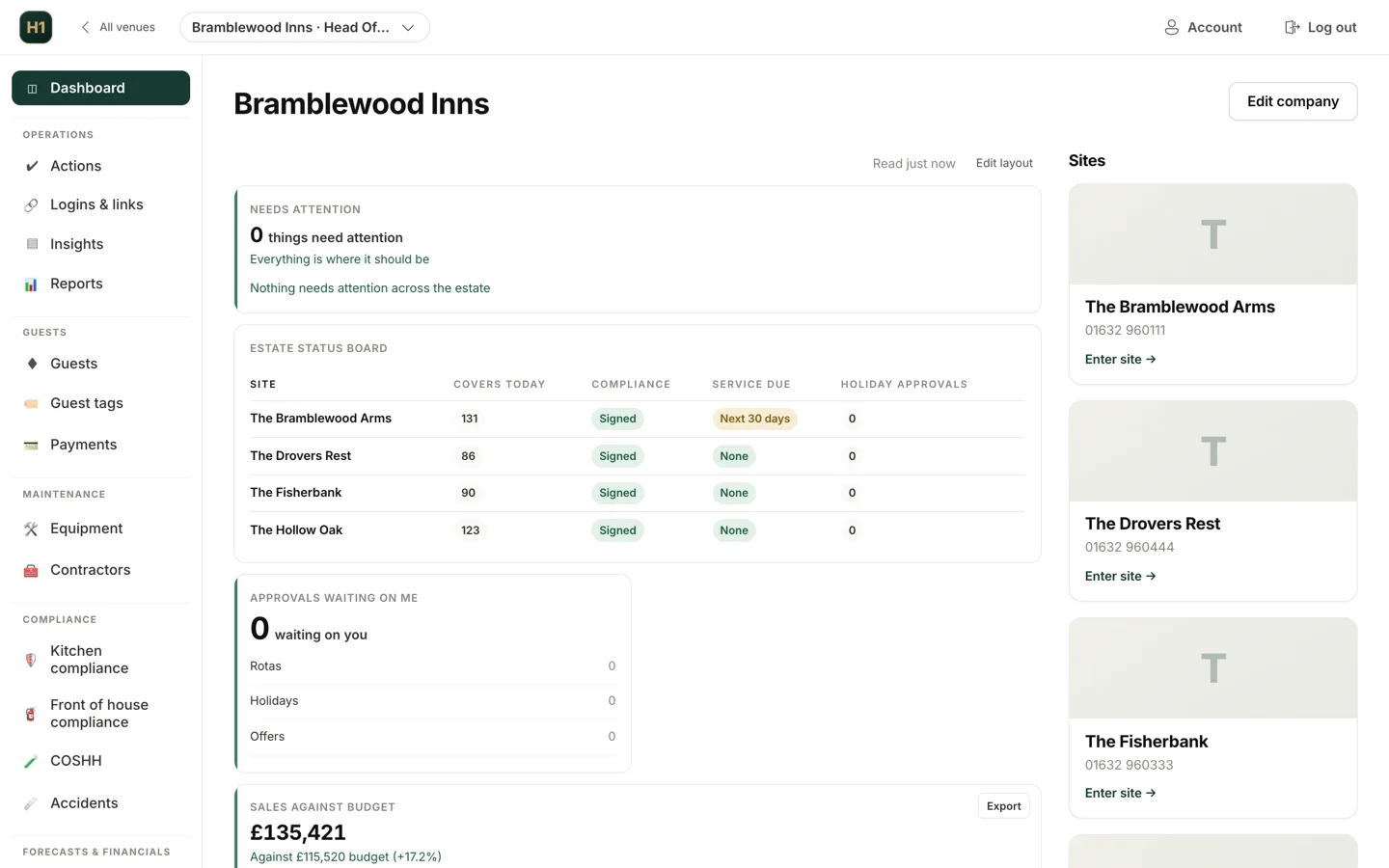
The estate at a glance, in the order it needs attention.
Not a dashboard of everything. A view of what is out of line: overdue compliance, unapproved rotas, sites tracking behind forecast, equipment past its service date.
Compliance status per site
Bookings and covers across the estate
Revenue and forecast
Equipment and service due
Customisable widget dashboard
Drill into any site
Permissions come from the org chart, not a spreadsheet.
The thing that breaks first in a growing group is who can see what. Hendra One models the actual structure: departments, roles and reporting lines, with permissions attached to roles rather than to people.
Per-action Yes or No
One-step promote and demote
Approval routes that follow the chart
Site and head office scoping
Credential vault with audited reveals
Full audit trail
Shared where it helps, separate where it matters.
A group wants one guest database and one set of policies. A guest wants to feel like they are booking the pub, not the estate. Both are true at once.
Shared guest database
Per-site branding and domains
Company policies, scoped
Group reporting
Central equipment register
Contractors directory
What changes when you go from one pub to three
The first pub runs on the licensee knowing everything. The second still works, badly, on them driving between the two. By the third, the operator is managing by exception and has no reliable way to spot the exceptions. That is usually the point where a group buys more software: a rota tool, an audit app, a compliance product, each per site, each with its own login and its own idea of who works where.
The cost of that is rarely the subscriptions. It is that no two systems agree on the staff list, guest records are split across sites, and there is no single place that says which pub is behind. Consolidating is worth doing for the visibility long before it is worth doing for the money, though the money follows: a typical pub pays £200 to £400 a month across separate vendors for what one system does.
Hendra One is built company-first, so head office is not a report bolted onto a single-site product. Every site shares one guest database, one compliance standard and one org chart, at £100 per site per month with no group tier.
Multi-site questions.
How is multi-site pricing worked out?
+
Every site is £100 per month excluding VAT, with no group tier and no minimum. Because separate booking, CRM, compliance and HR subscriptions each charge per site as well, the saving grows with the number of pubs rather than shrinking.
Can head office see everything without logging into each site?
+
Yes. Head office is its own workspace with an estate-wide view of compliance status, bookings, revenue and overdue items, and can drill into any single site from there. Nobody is keeping a spreadsheet of which pub is behind.
How do permissions work across an estate?
+
Permissions come from an org chart rather than a list of accounts. Each role gets per-action Yes or No on every feature, and someone changing job changes role once. Approval routes such as holiday sign-off follow the chart live, so a leaver needs no reassignment.
Is the guest database shared between sites?
+
Yes, at company level. A guest who books at two of your pubs is one record with one visit history, which is what makes group-wide marketing worth doing. Site-level staff still work in their own pub, controlled by permissions.
Can each pub keep its own branding?
+
Yes. Every site has its own brand settings, booking widget theming and optional custom domain, so guests see the pub rather than the group. The head office view is the only place the estate appears as one thing.
See it running on your own menus and your own tables.
A 30-minute walkthrough with someone who has run a service, not a sales deck.