Pub compliance software that replaces the folder nobody fills in.
It digitises Safer Food Better Business, the fire log, the accident book and COSHH. When the EHO walks in you hand them a link, not a binder. And a failed check escalates to a named person by role, so nothing gets quietly skipped.
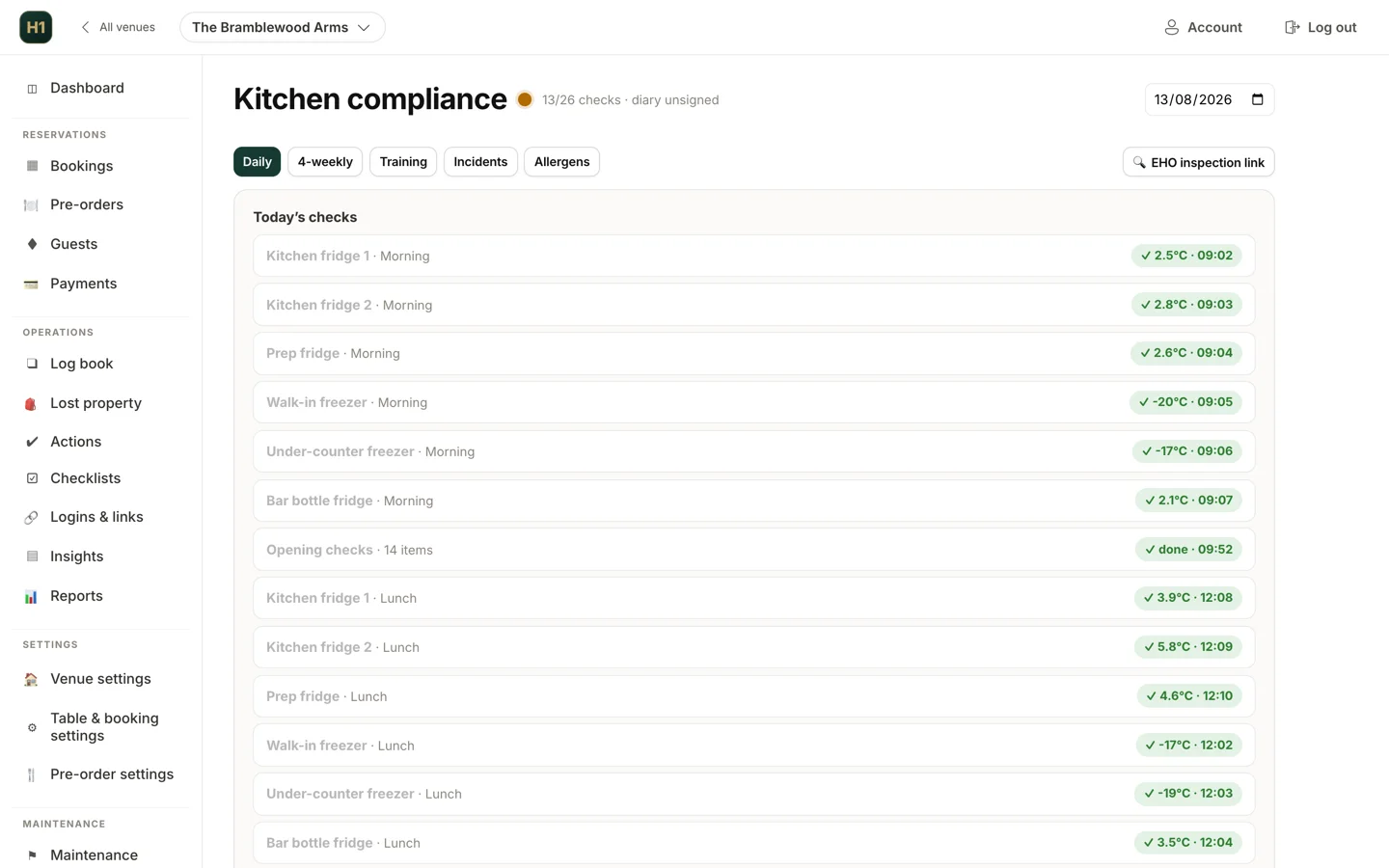
The records SFBB expects, captured as the shift happens.
Fridge and freezer temps, cooking, cooling and reheating targets, opening and closing checks, all on a phone behind the line rather than on a sheet that gets filled in from memory on Sunday night.
Temperature logs with targets
Enforced corrective actions
Signed daily diary
4-weekly review
Delivery and probe checks
Cleaning schedules and pest sightings
Hand the EHO a link, not a binder.
Inspection mode generates a time-limited link to a printable 28-day report: temperatures, checks, corrective actions and signatures, in order, with nothing missing because nothing could be closed without it.
Time-limited access
Printable 28-day report
Complete by construction
Failures climb the chain until somebody deals with them.
The reason paper compliance fails is not that people are careless. It is that a missed check on a Tuesday is invisible until an inspection. Here it is somebody’s problem within the hour.
Alerts by role, not by name
Quiet hours respected
Unresolved issues escalate upward
A Monday overdue digest
Fire, accidents, COSHH, training and allergens.
The compliance obligations a pub carries do not stop at the kitchen door, and neither does the module.
Fire safety pack
Digital accident book
COSHH register
Training matrix
Live allergen matrix
Policy register
Why digital food safety records hold up better than paper
A paper SFBB pack fails in predictable ways. It gets filled in retrospectively, so the times are wrong. Corrective actions are the field most often left blank, because the person writing it up on Sunday cannot remember what was done about Thursday’s fridge. Nobody notices a missing week until an inspection, and by then it cannot be fixed. And when a manager leaves, the escalation route in their head leaves with them.
Digital records address each of those directly. Entries carry the time they were actually made and the person who made them. A failure cannot be closed without a corrective action, so the field that matters most is the one that cannot be skipped. Overdue items surface immediately rather than at inspection. And escalation runs off the org chart, so it survives a change of staff.
Compliance in Hendra One shares the same sites, roles and permissions as bookings and the rota, and rolls up across an estate in the head office view. It is included in the flat price, not sold as a compliance product on top.
Compliance questions.
Is this a digital version of Safer Food Better Business?
+
The kitchen module mirrors SFBB: the same opening and closing checks, the same corrective-action logic when something fails, a daily diary signed with a drawn signature, and the 4-weekly review built on the FSA’s own 12 questions. It is designed to hold the records SFBB expects you to keep.
What happens when an EHO visits?
+
You switch on inspection mode and hand the officer a time-limited link to a printable 28-day report covering temperatures, checks, corrective actions and signatures. Nothing is emailed and nothing is printed in advance, and the link expires on its own.
Can we stop checks being skipped?
+
A failed check cannot be closed without a corrective action, and an out-of-range temperature alerts named people by role immediately. Anything left unresolved climbs the chain until someone deals with it, so a skipped check becomes somebody’s problem rather than a gap you find months later.
Does it cover fire safety and the accident book too?
+
Yes. Alarm tests with rotating call points, emergency lights, extinguishers, fire doors, escape routes and drills are all logged and escalated when overdue. The accident book is digital with RIDDOR flagging, consecutive report numbers and signatures.
Is compliance an add-on we pay extra for?
+
No. Compliance is included in the flat £100 per site per month, the same as every other module. It is the part most operators expect to be an upsell, and it is not.
See it running on your own menus and your own tables.
A 30-minute walkthrough with someone who has run a service, not a sales deck.